
Back to: Project Management Essentials – Free Taster Lesson
Welcome
In our previous lessons, we distinguished between projects and business-as-usual activities and explored their respective management approaches. Now, we delve into a critical question: What determines the success or failure of a project?
The Standish Group’s CHAOS Report, a seminal study analyzing thousands of IT projects over several decades, offers valuable insights into this question.
📊 Project Outcomes
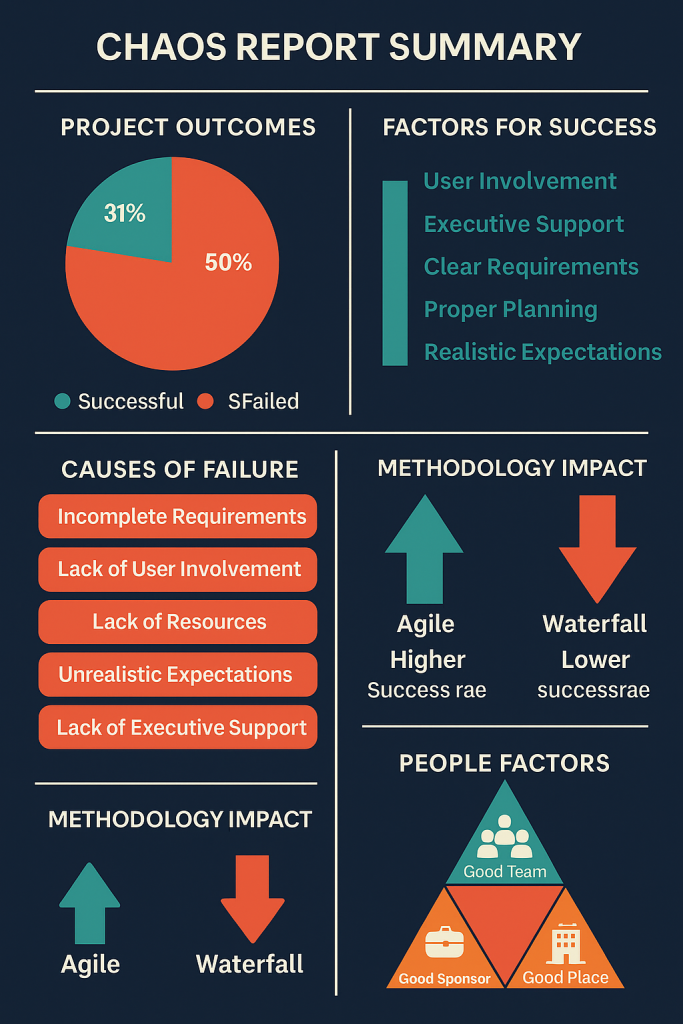
The CHAOS Report categorizes projects into three outcomes
- Successful: Completed on time, within budget, and with all promised features.
- Challenged: Completed but over budget, late, and/or with fewer features than initially specified.
- Failed: Cancelled before completion
According to the 2020 CHAOS Report:The Story+23Pillar+2Henny Portman’s Blog+2
- 31% of projects were successful.
- 50% were challenged.
- 19% failed.
✅ Key Factors for Project Success
The CHAOS Report identifies several factors that significantly contribute to project success:LinkedIn+1Medium+1
- User Involvement: Active participation of end-users throughout the project lifecycle ensures that the final product meets their needs.
- Executive Management Support: Strong leadership and commitment from top management provide direction and resources.
- Clear Requirements: Well-defined and understood project requirements reduce ambiguity and scope creep.
- Proper Planning: Comprehensive planning sets realistic timelines and resource allocation.
- Realistic Expectations: Setting achievable goals prevents disappointment and overextension.
⚠️ Common Causes of Project Failure
Conversely, the report highlights factors commonly associated with project failure:
- Incomplete Requirements: Lack of detailed and clear requirements leads to misunderstandings.
- Lack of User Involvement: Failure to engage users can result in a product that doesn’t meet their needs.
- Lack of Resources: Insufficient staffing, budget, or time hampers project progress.
- Unrealistic Expectations: Overambitious goals can set the project up for failure.
- Lack of Executive Support: Without backing from leadership, projects may lack direction and priority.
🧠 The Human Element: Teams, Sponsors, and Environment
The 2020 CHAOS Report emphasizes the importance of three human-centric factors:hennyportman.files.wordpress.com+23Pillar+2Reddit+2
The Good Team: A competent, cohesive, and communicative team is crucial.
The Good Sponsor: An engaged sponsor who provides clear vision and swift decision-making enhances success.
The Good Place: An organizational environment that supports collaboration and rapid execution fosters project success.
🔄 Methodology Matters: Agile vs. Waterfall
The choice of project management methodology also impacts success rates.
- Agile Projects: Characterized by iterative development and flexibility, Agile projects are more adaptable to change.
- Waterfall Projects: Following a linear and sequential approach, Waterfall projects can be less responsive to change.
Studies indicate that Agile projects have higher success rates compared to Waterfall projects.
⏱️ Decision Latency: The Silent Killer
Decision latency, or the delay in making decisions, can significantly hinder project progress.
- Low Decision Latency: Quick decision-making keeps the project moving and reduces bottlenecks.
- High Decision Latency: Delays in decisions can cause project stalls and increased costs.
Improving decision latency can lead to a substantial increase in project success rates.
📝 Final Thoughts
Understanding the factors that contribute to project success or failure is essential for effective project management. Key takeaways include:
- Engage users and stakeholders throughout the project.
- Ensure strong executive support and clear requirements.
- Foster a competent team and supportive environment.
- Choose an appropriate project management methodology.
- Minimize decision latency to maintain project momentum.Tigo Solutions+1California State University, Sacramento+1
By focusing on these areas, organizations can enhance their project outcomes and deliver greater value.